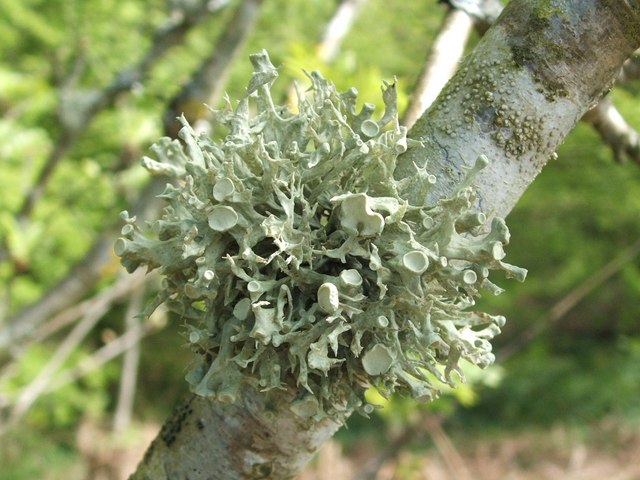
It was nearly 150 years ago that lichens were discovered. Lichens were shown to be a composite partnership of fungi and algae/cyanobacteria. The relationship was called symbiosis. This fundamental canon remained as a mainstay in biology for more than a century until in the second decade of the 21st century a home-schooled Ph.D. from Montana (Dr Tony Spiribille) showed that lichens were a tripartite partnership with two types of fungi – Ascomycetes and Basidiomyctes in partnership with the photobiont or photosynthetic energy supplier of light harvesting which comes in the form of algae or blue-greens. This finding revolutionized lichen biology and it is up to the lichenologists to conduct further investigations to see whether this phenomenon is a universal truth or a niche development in a subset of lichens.
Lichens are a mass bio-reservoir of bioactive compounds. One such compound is Vulpinic acid, which has been shown recently to be highly effective in destroying methicillin resistant Staphylococcus aureus (MRSA). The Vulpinic acid is hypothesized to be linked intimately with the development of the cortical (outer) basidiomycetes fungi in the lichen structures. It seems the distinguishing property of the two lichens (Bryoria fremontii and Byoria tortuosa) is the presence of a newly-discovered early evolving basidiomycetes which is suggested to produce Vulpinic acid, which is more readily available in the yellow lichens (Byoria tortuosa). The presence of this acid is hypothesized to be involved in the securing of the ‘love triangle’ between the two fungal varieties and an algal species – by ensuring there is no interference of other microbes. It appears that these three bedfellows give a ‘Tri-biosis’, an advantage to survive in harsh terrain that lichens are usually accustomed to.
The lesson to learn from this study is that science will always be susceptible to the carousal of change. Even a static science like human anatomy is dealing with finding new layers beneath the eye and new structures in the knee and lichens too have evolved from being “two is a company” to being three is a marriage. Still there are questions whether this phenomenon is only present in macro lichens or whether it is also found in cyanolichens. This should be a study in scarlet, a red hot area of scientific endeavor for budding lichenologists.
They say there are two winner and two losers in a love triangle, but here though there are no losers. All three appear to be unlikely bedfellows on beds of rocks and logs. It seems, there is more to the chemistry of sharing bonds and the physics of triangles. After all, biology supersedes them all by molding a three-way evolutionary wonder in the form of lichens. They say the genus Vulpes are true foxes, but these Vulpinic acid producing lichens seem to outfox everything else in their surrounding and make merry when the times are lean. Three it seems is not a crowd, just a blissful bigamy of the nuptials of three partners sharing one bed. That bed is the biological marvel called a lichen.

Dilantha Gunawardana, a molecular biologist/biochemist trained at the University of Melbourne, lives in a chimerical universe of science and poems. Dilantha’s poems have been accepted for publication /published in The Writing Disorder, Heart Wood Literary Magazine, Quadrant Online, Poets for Science, Canary Literary Magazine, Cordite Poetry Review, Forage, Kitaab, Creatrix, Eastlit, Cephalo Press and Zingara Poetry Review among others, while also contributing to three poetry anthologies, including his latest collection of Cancer themed poems which he penned while battling cancer. Dilantha made into the final three in the award for the best original poetry for the year 2024 in Sri Lanka’s State Literary Awards Ceremony and was also awarded the prize for “The emerging writer of the year – 2016” in the Godage National Literary Awards, Sri Lanka, while being shortlisted for the poetry prize, in the same awards ceremony. Dilantha lives in a beautiful island country shaped like a teardrop, Sri Lanka, known for its black tea, true cinnamon, the love of a colonial game called cricket, passion for spicy curries and was formed as recently as ~23 to ~5 million years ago, breaking away from the Indian landmass. Dilantha in his free time takes part in pub quizzes, maintains a photography blog dedicated to birds, forays into prose writing, and plays basketball, soccer and cricket. Dilantha’s poems can be found at: https://poemsfromceylon.com/

 Curiosity driven life